
Commercial
Accounting AI Software for Australian Practices
Accounting AI software is most useful when it supports a defined accounting workflow, keeps source records retrievable and leaves people to review exceptions. For Australian practices, choose tools that connect to existing ledger data, document their outputs and fit privacy and security controls rather than treating a general chatbot as a replacement for accounting systems.

- What should accounting AI software do?
- How electronic record keeping affects AI workflows
- What does the 2024 survey say about AI adoption?
- How can connected accounting data reduce manual reporting?
What should accounting AI software do?
Accounting AI software should bring ledger information into a repeatable workflow, surface items needing judgement and preserve a traceable path back to underlying records. It is not a substitute for the practice’s accounting platform or professional review. A useful implementation starts with a narrow workflow, defined inputs, review points and an accountable user.
That distinction matters as the market changes. In its 7 April 2026 discussion of accounting platforms and generative AI, CPA Australia describes concerns that businesses may replace specialist software with questions put directly to ChatGPT or Claude. For a practice, useful software needs structured client data, not merely plausible text responses.
Assess a proposed workflow by asking whether it can reliably handle the work around the ledger:
- where the information comes from and whether the user can see the source transaction;
- which items are processed consistently and which are sent to a reviewer;
- how corrections, approvals and exceptions are recorded; and
- whether the resulting records remain accessible after a software or process change.
This approach separates automation from judgement. It also gives partners a clearer basis for deciding whether a task is suitable for workflow software, a human review queue or an existing accounting platform feature.
How electronic record keeping affects AI workflows
Electronic outputs can sit within an accounting workflow, but they must remain understandable, accessible and capable of explaining the transactions they represent. The ATO’s Taxation Ruling TR 2005/9 says electronic records have the same record-keeping requirements as paper records. System knowledge, change documentation and recoverability are therefore practical selection criteria.
The ruling applies to electronic records created from business transactions, including transactions conducted through the internet, for the purposes of section 262A of the Income Tax Assessment Act 1936. It states that where systems change over time, records should be kept so original data can be reconstructed.
As the ATO puts it, “electronic records are subject to the same record keeping requirements under the ITAA 1936 as paper records.” That is a useful guardrail for practices considering AI-assisted categorisation, document extraction or workpaper preparation: retain the connection between the output and the transaction it is intended to explain.
| Workflow area | Practical question | Useful evidence |
|---|---|---|
| Input data | Can the user identify the originating record? | Linked transaction, document or ledger entry |
| Review | Which items require human judgement? | Exception queue and reviewer notes |
| System changes | Can prior information be reconstructed? | Documented migration and retained records |
What does the 2024 survey say about AI adoption?
Australian businesses were less advanced in AI adoption than other surveyed Asia-Pacific markets in CPA Australia’s 2024 research, while digital strategy was associated with stronger reported profitability. The findings do not prove that a particular tool causes better results, but they support a deliberate approach: define the workflow, set controls and measure whether the change is useful.
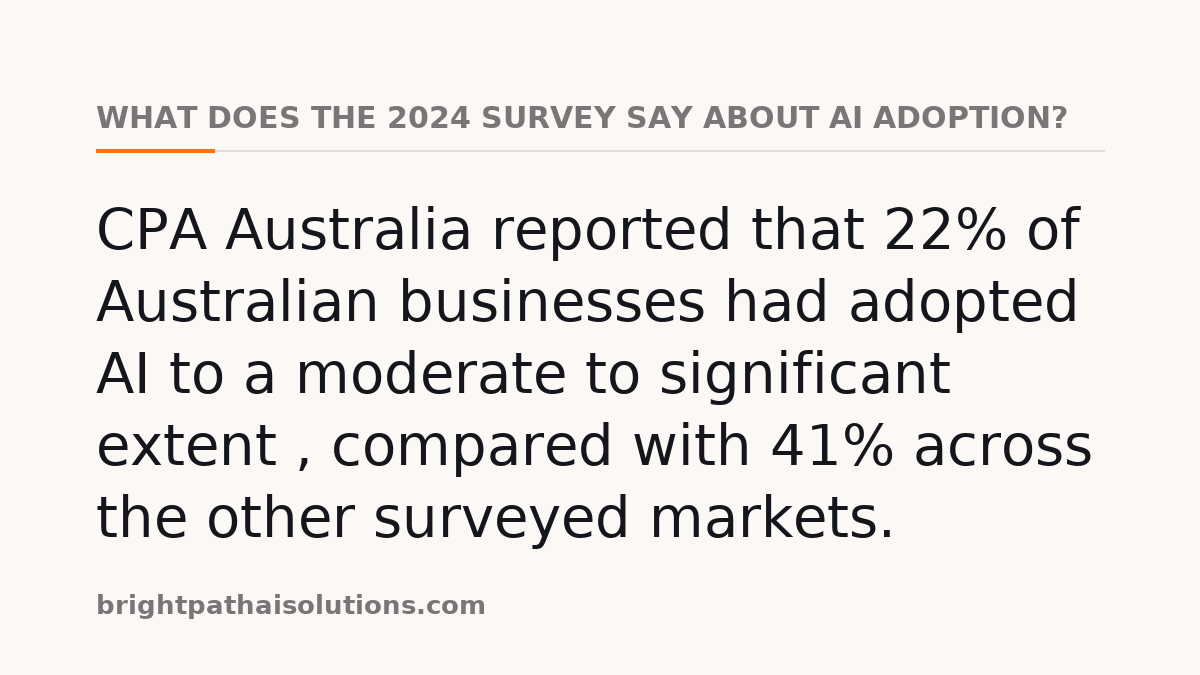
CPA Australia reported that 22% of Australian businesses had adopted AI to a moderate to significant extent, compared with 41% across the other surveyed markets. The same 2024 survey, conducted from 10 June to 15 July and based on 1,060 accounting and finance professionals, found that 34% of Australian businesses had never used AI, compared with 22% elsewhere in the surveyed region.
Digital planning showed another gap. CPA Australia found that 53% of Australian businesses had a digital strategy, compared with 69% of businesses outside Australia in the surveyed Asia-Pacific markets. Among businesses with a strategy, 69% reported increased profitability in their most recent financial year, compared with 35% of businesses without one.
For accounting practices, these figures are a reason to avoid buying software solely because it is labelled AI. A written workflow decision can identify the client data involved, the person who reviews exceptions, the records retained and the result the practice will assess.
How can connected accounting data reduce manual reporting?
Connected accounting data can reduce repeated entry where a reporting process lets users select existing accounts or categories and generate totals from them. The Australian Bureau of Statistics uses this model in its Business Reporting service for eligible Xero, MYOB and QuickBooks users completing the Quarterly Business Indicators Survey. Users still review the information before submission.
The ABS explains that selected accounts can be saved securely for later reports, creating a prefilled report for review and submission. Its guidance states, “Connecting to accounting software streamlines the reporting process, eliminating the risk of manual errors and saving you time.”
This is a practical model for evaluating accounting workflow software. The value is not simply that data moves automatically; it is that the connection reduces repeated selection and entry while preserving a review step. A practice should understand which accounts are included, how mappings are maintained and what a reviewer sees before an output is used.
For the repetitive side of bookkeeping, DeskMate can help practices automate routine workflow steps rather than rebuilding the same work by hand; explore what DeskMate automates and review its Security & Trust information when assessing how automation fits your processes.
The best accounting AI software fits around established accounting systems, structured records and human accountability. Start with one repeatable task, retain the supporting information, review exceptions and expand only when the workflow remains clear to both the practice and its clients.
Sources
Every figure, date and obligation above was checked against these documents before publication.
- Could AI swallow the accounting software market? | CPA Australia
- Income_tax_record_keeping_electronic_records_TR2005 9
- Failure to embrace new tech is holding Australian businesses back | CPA Australia
- Why should I connect to my accounting software in ABS Business Reporting? | Australian Bureau of Statistics
Keeping the record is the hard part.
DeskMate writes who ran a skill, what it touched and who approved it, every time — as a by-product of the work rather than a log someone has to remember.