
Knowledge
When to use eInvoicing in Australia
Use eInvoicing in Australia when both trading partners can send and receive invoices through the Peppol network, using accredited access points and a resolvable participant ID. The supplied ATO guidance does not establish a universal 2022 or 2023 adoption deadline for every business; it establishes the network, format and directory conditions for exchanging eInvoices.
eInvoicing is a software-to-software exchange method, rather than a PDF invoice sent as an email attachment. The ATO explains that eInvoicing exchanges invoices directly between suppliers' and buyers' software, making it relevant when clients and their trading partners can use the same networked channel.
For accounting and bookkeeping practices, the question is operational: can the client create an invoice in compatible software, can the recipient receive it, and can the network locate the recipient? Those checks are more useful than treating eInvoicing as a general replacement for every existing invoice process.
- How Peppol exchanges an eInvoice
- How to check whether a business can receive
- When eInvoicing has a stronger business case
How Peppol exchanges an eInvoice
Peppol exchanges an eInvoice through four connected stages: the supplier creates it, the supplier's access point validates and sends it, the buyer's access point receives and validates it, and the buyer receives it in business software. This is the source-backed process to use when a supplier and buyer are both connected to the Peppol network.
The ATO describes Peppol as an international eProcurement framework whose network and document specifications standardise how business information is structured and exchanged. Access points connect businesses to that network and support the exchange of invoices and other documents.
As the ATO states, "Peppol uses a 4-corner model to exchange procurement documents and data." The four-corner model means a business does not need to build a separate direct connection with every customer or supplier on the network.
- The supplier creates the eInvoice in its business software.
- The supplier's access point validates and sends it after address lookup.
- The buyer's access point receives and validates the invoice.
- The buyer receives the invoice in its business software.
The standardisation point matters for format discussions. The supplied ATO material supports describing Peppol document specifications as the structure for exchanged business information, but it does not set out a separate universal file-format rule or a blanket mandate for all Australian businesses during 2022 or 2023.
How to check whether a business can receive
Check the Peppol Directory before planning an eInvoice exchange, because it identifies entities registered on the network and their receiving capabilities. Australian businesses typically use their ABN as a Peppol participant ID, although the directory only publishes receivers' details and a sender-only business may not appear in a search.
The ATO says the Peppol Directory can be searched using a trading name or ABN. The directory is administered by OpenPeppol and helps practices establish whether a trading partner is connected to receive Peppol eInvoices.
Every directory participant identifier has 3 components: an identifier scheme, an International Code Designator value and a unique identifier denoted by that ICD. For most Australian businesses using an ABN, the ATO identifies 0151 as the ICD value.
- The identifier scheme is iso6523-actorid-upis.
- The usual Australian ABN ICD is 0151.
- The final component is the unique identifier, typically the business's ABN.
The ATO gives its own participant ID as iso6523-actorid-upis::0151:51824753556. That example is useful for checking the expected structure, but it is not a substitute for confirming the intended recipient's current directory entry.
Directory presence is not an identity assurance step. The ATO says businesses should complete appropriate identity and know-your-customer checks before dealing with a new trading partner, regardless of that party's Peppol registration status.
When eInvoicing has a stronger business case
eInvoicing has a stronger documented business-case use where invoice volumes are substantial, trading partners are ready to use Peppol, and the practice can assess current processing channels and times. The ATO's assessment tool is aimed at medium and large enterprises and uses a one-year analysis, so its outputs are indicative rather than a universal adoption rule.
The ATO's Peppol eInvoicing value assessment is based on a 1-year analysis. It asks organisations to enter information about invoicing volumes, channels and processing times to obtain more tailored results.
The ATO's value assessment report defines its intended high-volume audience as businesses handling 25,000 or more invoices. That threshold is part of a one-year scenario used by the ATO to estimate savings, return on investment and payback period in the first year of adoption.
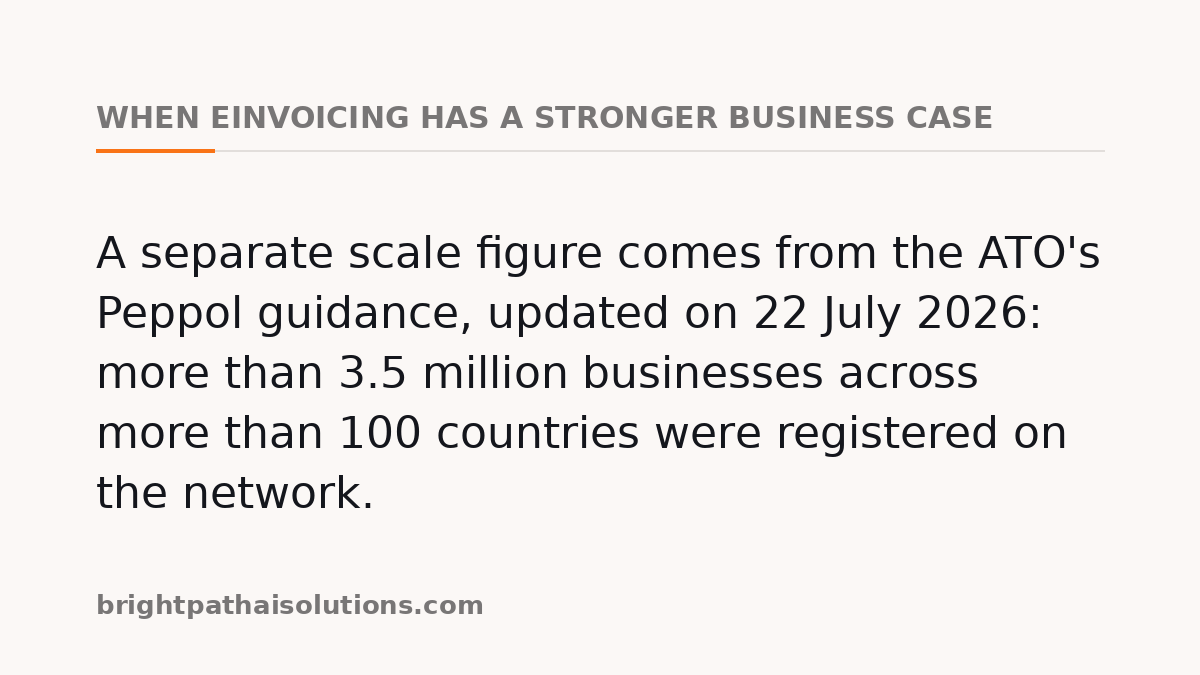
A separate scale figure comes from the ATO's Peppol guidance, updated on 22 July 2026: more than 3.5 million businesses across more than 100 countries were registered on the network. This figure describes network reach, not the number of Australian businesses required to adopt eInvoicing.
For a client review, document whether the software has an access-point arrangement, whether major suppliers and customers can receive, and whether the recipient identifier resolves. This keeps advice focused on supported network conditions rather than an unsupported claim of a universal 2022 or 2023 rollout obligation.
For separate supplier-invoice work rather than Peppol routing, DeskMate can split batches of supplier invoices supplied as PDFs or photographs into individual bills and stage them as drafts for review; see the DeskMate skill library and Security & Trust information.
The practical rule is simple: use eInvoicing when both sides are Peppol-enabled, the recipient can be identified for routing, and the invoice can move through accredited access points using Peppol's structured exchange model. Do not represent the supplied ATO material as imposing a blanket adoption deadline on every Australian business.
| business | exchange |
|---|---|
| The supplier | creates the eInvoice in its business software. |
| The supplier's access point | validates and sends it after address lookup. |
| The buyer's access point | receives and validates the invoice. |
| The buyer | receives the invoice in its business software. |
Sources
Every figure, date and obligation above was checked against these documents before publication.
Keeping the record is the hard part.
DeskMate writes who ran a skill, what it touched and who approved it, every time — as a by-product of the work rather than a log someone has to remember.